Day 9 was a little different from the previous few days because I was working from home.
And honestly, that made a pretty big difference.
Since I didn't have to travel to the office, I had my personal laptop available while working. Whenever I got a small window of free time between office tasks, I would switch over to my personal laptop and work on GATE preparation.
It wasn't exactly a clean study session. It was more like:
Office work → small break → GATE question → office work → another small break → another GATE question.
Not exactly the picture of a peaceful study routine, but apparently this is what preparation looks like when you have a job and are trying to squeeze GATE into the remaining pieces of the day.
Questions, Finally
One of the things I wanted to improve after Day 8 was question practice.
I had noticed that the previous week had been pretty bad in that department. I had spent time studying lectures and concepts, but actual question practice had almost disappeared.
So on Day 9, I managed to do around 15 questions.
I solved around 5 C Programming questions, getting 4 out of 5 correct.
I also solved around 10 Digital Logic questions, with roughly 80% accuracy.
I had originally thought about doing around five questions from every completed subject, but with office work going on, that obviously wasn't going to happen. Still, getting 15 questions done felt much better than what I had been doing previously.
And that was probably the biggest positive of the day.
The Data Structures Test
I also had a Data Structures topic-wise test scheduled for the day.
The topic was Stacks and Queues.
I scored approximately 10.33 out of 25.
I don't remember the exact number of questions I got correct, incorrect, or skipped, so I'm leaving those numbers blank rather than pretending I have the memory of a perfectly organised human being.
The interesting part, though, wasn't really the score.
I am already fairly comfortable with Data Structures because I had studied DSA seriously during my placement preparation. So I didn't feel that the test exposed some huge conceptual weakness.
The bigger problem was time.
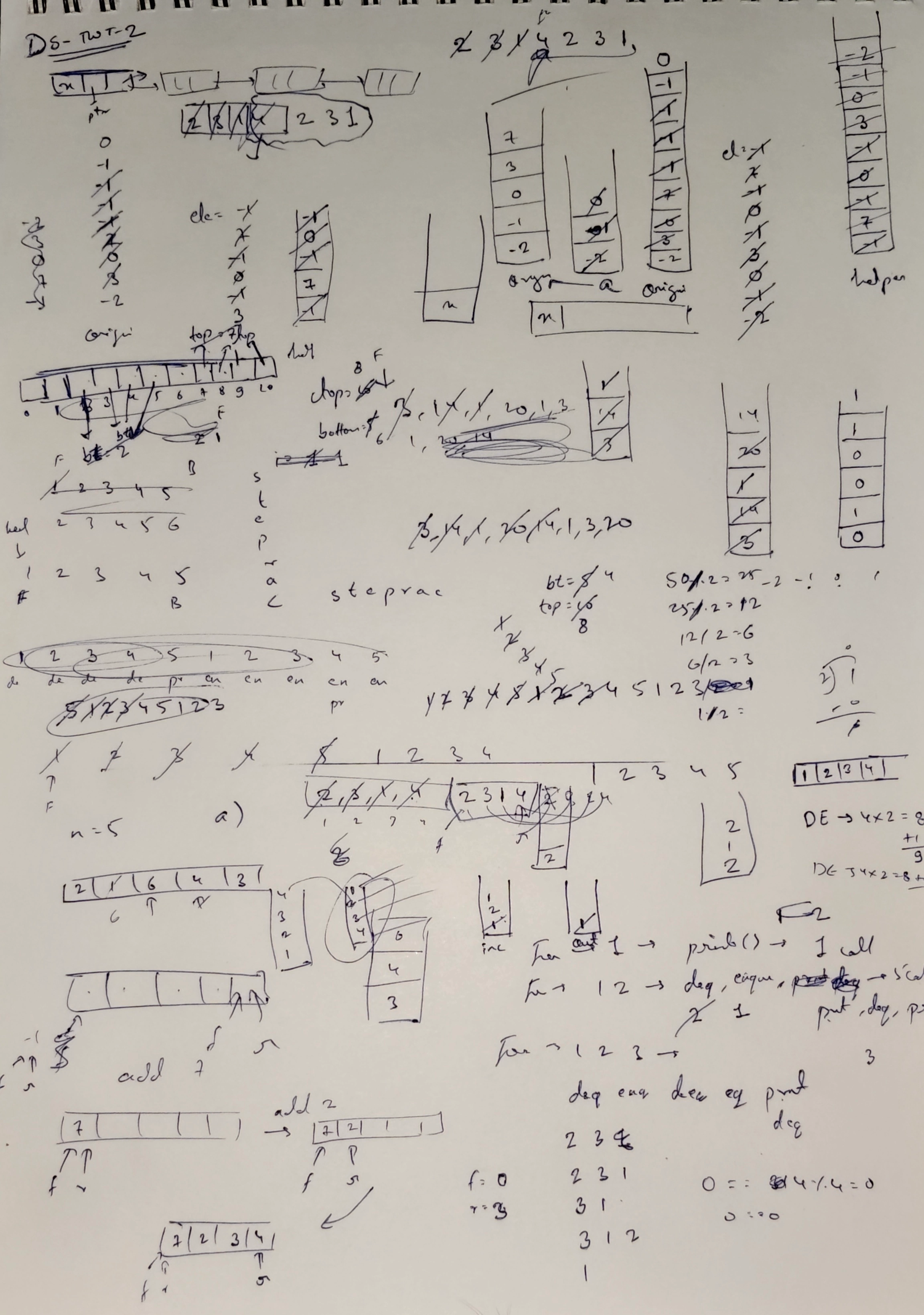
I am a relatively slow thinker when solving unfamiliar questions. I need some time to read the question properly, understand what it is asking, figure out what concept is involved, and then decide how to approach it.
That becomes a problem in a timed test.
I ended up leaving several questions because I felt they were taking too much time.
But then came the interesting part.
During the analysis, I was able to solve almost every question.
Except for maybe one or two questions, the concepts were not really the problem.
I knew how to solve them.
I just wasn't able to get there quickly enough during the test.
The Actual Problem: Practice
This made me think about something important.
Maybe I don't actually have a Data Structures problem.
I have a question-practice problem.
If I have solved a particular type of question many times before, I don't need to spend so much time figuring out what is happening. I start recognising the pattern.
I see the question and my brain can go:
"Oh, this is that kind of problem."
But when I haven't practised a topic for three or four months, everything has to be recalled from scratch.
What is the question asking?
Which concept applies?
Is there a formula?
Is there some specific application?
Have I seen this pattern before?
All of that takes time.
So my takeaway from the test wasn't that I suddenly became bad at Data Structures. It was that I need more exposure to questions if I want my recall and solving speed to improve.
The fact that I could solve almost all of them during analysis actually made me feel a little better.
The knowledge isn't completely gone.
It just needs to become faster.
A Surprisingly Productive Day
By the time I finished work, I was pretty exhausted.
Multitasking between office work and GATE preparation isn't exactly relaxing.
But despite being tired, I felt genuinely proud and happy when I looked back at the day.
I had managed to do something I wasn't sure I would be able to do while working.
I solved around 15 questions.
I took a Data Structures test.
I analysed it.
And I did all of that while still completing my work.
It wasn't the perfect GATE preparation day.
It wasn't some six-hour deep-work masterpiece.
But it was productive.
And sometimes that's enough.
Tomorrow
Day 10 is going to be different because I'll be going back to the office.
Because of that, I don't want to create some unrealistic target like "Tomorrow I must solve exactly X questions."
If I get time, I'll practise questions.
But the bigger priority right now is still finishing the syllabus by the end of October.
Computer Networks is also slightly behind, by roughly three to four lectures, so I need to keep pushing that forward.
For now, the lesson from Day 9 is pretty simple:
Knowing a concept and being able to use it quickly in a timed test are two different things.
And apparently, the only way to bridge that gap is the horribly revolutionary technique known as actually solving more questions.
Humanity has survived another breakthrough.
What do you think?
Studying for GATE is less lonely when we're all figuring it out together.
Loading comments...