Sunday turned out to be pretty similar to Saturday. I didn't study much, but I did manage to complete my second C Programming subject-wise test and watch one Computer Networks lecture.
It wasn't the productive weekend I had hoped for, but at least I managed to get a little work done.
What I Studied Today
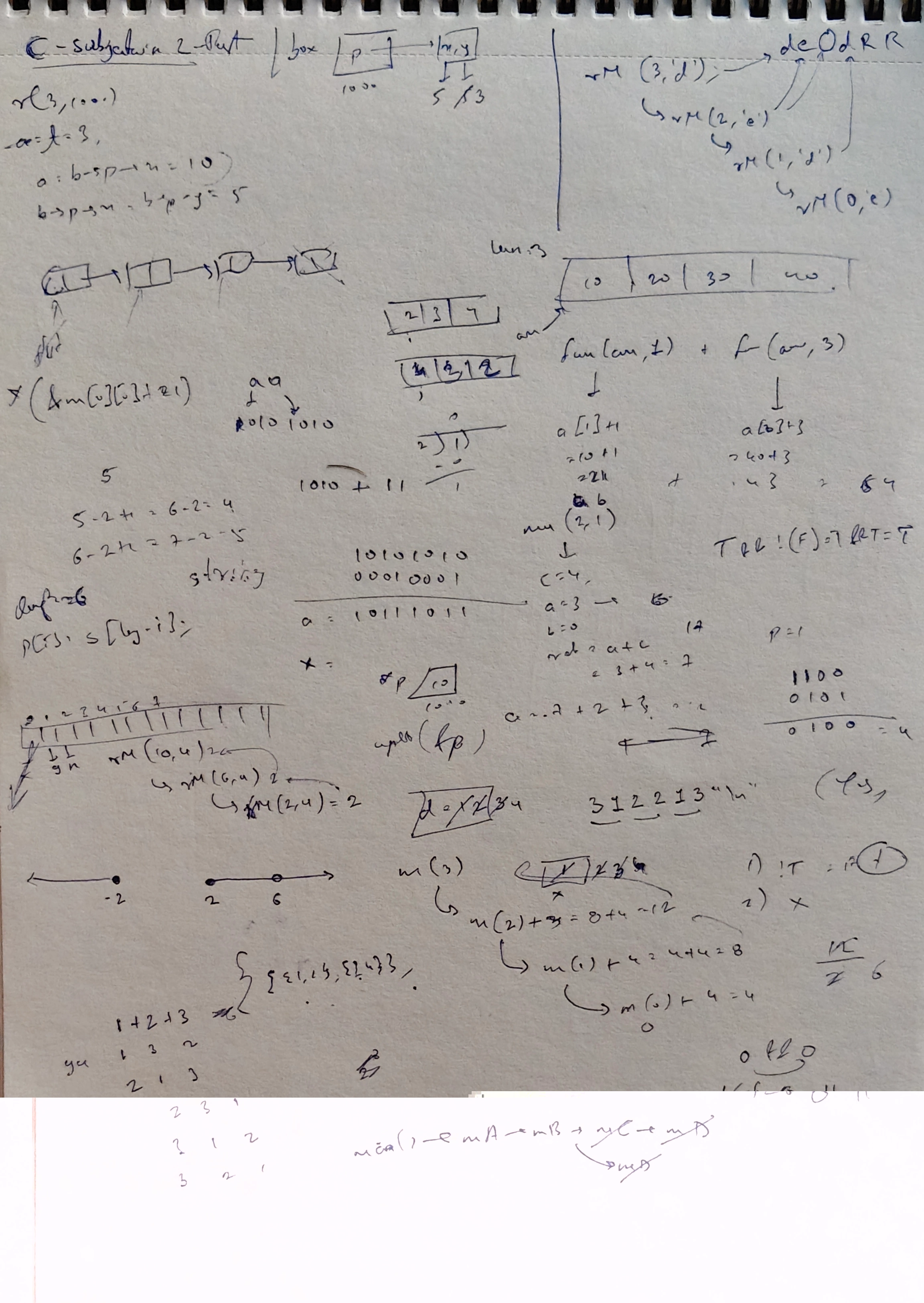
My main academic activity was taking C Programming Subject-wise Test 2.
Apart from that, I studied one Computer Networks lecture on timeout timer algorithms. The lecture covered the basic RTT estimation algorithm and Jacobson's algorithm.
I also spent some time thinking about a problem that keeps showing up in my tests: managing time without losing confidence in my answers.
C Programming Test 2: 32 Out of 45
I scored 32 out of 45 marks in my second C Programming subject-wise test.
The test had 30 questions, and my result was:
- Correct: 23
- Incorrect: 2
- Skipped: 5
I'm happy that I managed to complete the test, but there's still something I need to work on.
During the test, I again used my phone to check whether my answers were correct. I don't know why I keep doing this, but I think it has something to do with how much time I spend solving certain questions.
Sometimes, I spend six to eight minutes on a question that should ideally take around three minutes. After putting in that much effort, I want to make sure I haven't marked the wrong answer.
The problem is that this habit doesn't help me build confidence in my own reasoning. And it also means my practice test isn't really simulating exam conditions.
For my next test, I'm going to try keeping my phone away from me completely. I'll see how that goes.
The Time Management Problem
This is something I've been struggling with for a while.
My subject-wise tests generally have 15 questions, and I get 45 minutes to solve them. That works out to an average of three minutes per question.
But the average doesn't always match reality.
Some questions take longer, especially when I'm trying to understand a new concept or work through a calculation. If I spend six to eight minutes on one question, I lose time that could have been used elsewhere.
We've discussed the usual strategy of solving a paper in multiple phases: first the easier questions, then the harder ones, and finally a review.
Honestly, I've tried this approach many times, and it hasn't worked well for me.
When I move through the paper sequentially, I often don't get enough time to return to the questions I've marked. By the time I reach the end, the remaining time is already occupied by questions I haven't attempted yet.
So, I need to figure out how to manage my time without blindly following a strategy that doesn't suit me.
I'll give the suggested approach another try, but I also want to understand what actually works for me.
Computer Networks: Timeout Timer Algorithms
I also completed one Computer Networks lecture on timeout timer algorithms.
The lecture covered basic RTT estimation and Jacobson's algorithm.
I remembered the general idea of the basic formula, although I wasn't able to recall the exact expression properly during our discussion.
The basic RTT estimation formula is:
EstimatedRTT = (1 − α) × PreviousEstimatedRTT + α × SampleRTT
Jacobson's algorithm also considers the variation in RTT when calculating the retransmission timeout.
This was a useful reminder that remembering the general idea of a formula isn't always enough. I need to be able to recall it correctly and apply it to numerical questions.
A Slow Weekend
Looking back, Saturday and Sunday were both relatively unproductive.
I spent Saturday with my girlfriend and didn't study. On Sunday, I managed one C Programming test and one CN lecture, but I didn't complete the weekend practice targets or pending TOC notes.
I don't want to pretend that this was a highly productive weekend. It wasn't.
At the same time, I don't want to ignore the work I did manage to complete.
The bigger issue is figuring out how to balance my TCS job, personal life, and GATE CSE 2027 preparation without repeatedly missing the study targets I've set for myself.
What I Realized Today
My biggest realization today was about my test-taking habits.
I know that I need to improve my time management, but simply following a popular strategy isn't necessarily going to solve the problem.
I need to understand why I'm spending so much time on certain questions, why I keep checking answers on my phone, and how I can build confidence in my own reasoning.
My goal is still a single-digit rank in GATE CSE 2027. I know that reaching it will require serious effort, and I'm willing to work for it.
But the next step is to turn that determination into practical changes that I can actually measure.
Tomorrow
I'll discuss Monday's preparation separately.
For now, Sunday is recorded honestly: a slow study day, a C Programming test, one CN lecture, and another reminder that I need to improve how I approach timed tests.
Day 7 complete.
What do you think?
Studying for GATE is less lonely when we're all figuring it out together.
Loading comments...